This blog is dedicated to values and lessons we can learn from the professional / corporate sector. Knowing and upholding values such as truthfulness, trust, balance, adaptability, we believe, can help us not only in our long-term professional growth but also bring along with it a sense of deep contentment.
Do People Burnout Faster in the Corporate Sector?
Sivarama Krishnan
Three decades ago, when I embarked on my professional journey, the country was experiencing significant transformation, creating a strong drive for growth and ambition among us. What mattered to most of us was performing quality work and pursuing emerging opportunities. I recall a senior colleague who consistently shared two guiding principles: first, the importance of having a genuine passion for your work, and the second is - value of following guidance with dedication. He often referred to a renowned saying from a saint in Rishikesh—"Jano na tho Mano," meaning "either learn or follow." This philosophy became central to our approach at work. Engaging in tasks with enthusiasm and within areas of interest leads to professional fulfilment and joy.
Over the years, the perception that individuals experience burnout in the corporate sector has become increasingly widespread. But, upon closer analysis of Swami Vivekananda’s lectures, we can argue that the burnout may be less attributable to the industry itself and more closely related to one's personal mindset, decisions, and sense of purpose. Swami Vivekananda consistently asserted that work itself does not inherently lead to exhaustion or burnout; rather, it is the attachment to the results of work that does. In his lectures on Karma Yoga, he articulated two key principles. First, organisations should focus on the processes and means, rather than solely on end outcomes—though this topic extends beyond the scope of this article. Second, when individuals are motivated by external rewards such as status, monetary gain, or fear of failure, it usually results in burnout. However, when work is undertaken in the spirit of worship and service without attachment to the results, it serves as a source of strength and happiness.
Swamiji stressed the importance of freedom of thought and conscious choice warning against mechanical living, urging individuals to understand their own nature (svabhava). When one chooses the work consciously, aligns it with their svabhava, and performs it in the spirit of detachment and service, work is more satisfactory and not a cause of burnout.


How to Stay Calm When Both Work and Home Make Demands
Sakshi Goyal
I enjoy my work. I love to take up challenging tasks. I strongly believe that one needs to work on building skills and the rest (money, fame, position etc.) automatically follow. Working late nights, making presentations, digging interesting insights from the data, early morning meetings in case of different time zones never feel like a burden.
This was all possible until home began demanding my attention simultaneously. Our 7-year-old son, my husband and I were in total sync in managing daily routines where my husband went for work and my son used to be in daycare until 6 pm. There were only some days that adjustment was required when our son was ill and one of us was needed to take care of him. But a growing child has growing demands. He no longer wanted to go to day care as his all friends were now grown up too and he wanted to spend time playing sports with his age group. The fights among friends were no more a momentary thing but would bring more emotional feelings. His growing interest in football and rigorous practice sessions needed a more enriching diet. A sense of guilt started creeping in that I was not able to pay attention to his growing needs (emotional, physical, developmental). At the same time, growth in career came in, the nature of my work changed. Many stakeholders would mean many expectations. More expectations would mean increased availability at work. On the other hand, keeping sync between my husband and me became a challenge.
Was I not able to effectively balance work and home or did I not have the right spirit to support my family? Was my family expecting too much from me or was I not able to manage time? These questions troubled me. Guilt raced with self-doubt, a deadly combination leading towards a loop of disrupted clarity, decreased focus, and decreased performance.
This was the place where I stopped becoming critical of myself and my situation but focused on accepting – myself and the situation. I changed the questions I asked myself. What matters most to me? What is it that I cannot afford to compromise on? What is my priority at the moment? How can I best utilize my time? Out of the options available, what is the basis of response - present need or future need? Do I talk to someone and take guidance?
As I got the answers to the above, deeper self-reflection took me to the journey where "work-life balance" became a misleading term because it implied a perfect 50/50 split that stays still. Rather work-life integration or counterbalancing—where you accept that one side will always be "louder" than the other at any given time, became my saving mantra. Understanding the power of saying "not right now" instead of "no". Success isn't doing it all, it’s being present in the room you are currently standing in. Swami Vivekananda mentions in the talk “Powers of the Mind” that we need to learn to concentrate and also learn detachment at the same time. Calmness is a default by-product of clarity in priority, self-discipline, increased focus and mastering the art of detachment.
What helped me was remembering that it is not an overnight change that one can bring. It’s a journey of self-mastery to be uncovered. Being compassionate with oneself. One may take less or more time than others. Focus on the journey.
Handling Stress in the Corporate World
Suresh Srinivasan
Every individual on this planet wants to be happy and wants to live his/her life with comfort, stress-free, enjoying with friends and family. A student in her final year of studies is looking to graduate and get a lucrative job in the corporate sector or a government job. A working employee expects to grow in his career and looking for promotion, bonus, increments and other benefits. But there lies the catch! The gap between what we have and what we wish for, keeps growing bigger and bigger and this leads to a lot of dissatisfaction, frustration, depression and the dreadful word “Stress”.
With the world turning increasingly “VUCA” – Volatile, Uncertain, Complex and Ambiguous, the number of disgruntled employees in the corporate sector is increasing and we commonly hear a lot of talk on employee stress, pressure of work, disgruntlement and early health problems!
In my journey of forty plus years in the corporate sector, I have seen a radical change in the Employer-Employee relationships. When I passed out of college, getting a job was considered a luxury and if it was a government job, it was a bonanza! Very few contemplated a job change. You had employees who had completed 4 decades in the organization. Fast forward to today’s times, you do not see any employee planning to spend more than two or three years in a job. Moreover, employers also have no qualms in laying off persons due to falling profits in a quarter! Loyalty has become a forgotten word in the corporate dictionary today.
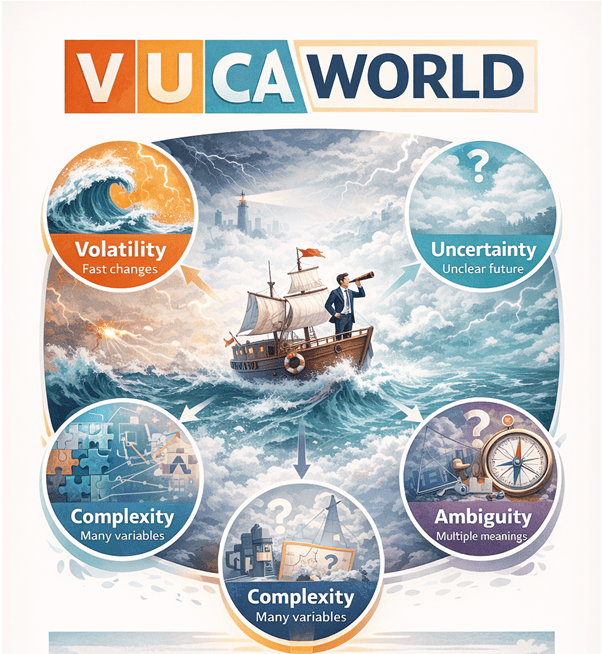
Why is there so much disillusionment in today’s Corporate World? We hear of burn-out, work-life imbalance, young age heart ailments, suicidal thoughts, marital discords and lots more. A look into some of the common causes of these myriad problems at work
1.Role mis-fit: This is one of the most common reasons for stress at work. In our anxiety and eagerness to get a job and more so, in a company of repute, we compromise on our actual skills and talents and accept a work responsibility not suited to our tastes and liking. This leads to a gradual sense of monotony, listlessness leading to inefficiency and ultimately stress.
2.Toxic Environment: Poor workplace conditions, long hours of work, undefined hierarchy, biased management, poor appraisal systems, arbitrary decision making, lack of respect among peers all contribute to feeling of despair and stress
3. Job Insecurity: Frequent churns and layoffs in the company, a hire and fire culture and changing economic conditions affecting the company may lead to a constant fear of retaining your place in the team.
4.Heavy Workload: This has become a norm in today’s corporate world where the employer in order to reduce manpower costs, keeps down-sizing the company and expects each individual to take up more and more workload and responsibility.

How do we overcome these challenges and pitfalls and stay calm and stress free?
1.Self-Belief: This is vital and most important. Never stop believing in yourself and your infinite possibilities. Each challenge, if carefully analyzed and dissected with your own unique lens, will give you a solution which will help you surmount the challenges.
2.Acceptance: The world is not ideal and it would be foolhardy to expect it to change the way you want it to be. Accept the situation for what it is and reflect on how to tackle the situation. Remember, acceptance is not resignation to the situation or tolerating a situation! It only means acknowledging that there is a problem!
3.Continuously expand yourself: Keep improving your skills and strengths. If you are given a mundane work, find something in that work which you can improve or make it interesting. An accountant going through a multitude of figures and numbers may find it monotonous but if he is able to find a creative way to sift through the accounts, he will start enjoying it! Match your strengths and skills to the challenges of the job and you will find your flow!!*
4.Live in harmony: Make as many like-minded friends and peers. Create a social environment where you can relax and rejuvenate
5.Have a mentor: Find someone you can trust and confide. Seek advice and this may help give a new perspective to the problems.
6.Be curious and creative in whatever you do: Have an inquisitive mind and explore beyond your work. Learn what the other departments, and other functional groups are doing. Read what is happening around you, new ideas, concepts, innovations, etc. Never give up on learning!
7.Always follow your Dharma: Do not compromise on your values and beliefs. This may sound counter-intuitive, but in the long run, it pays
8.Seek perfection: Strive to continuously improve, little by little, Kaizen after Kaizen. It will give you tremendous satisfaction and courage to take up bigger challenges and maybe achieve breakthrough results.
9.Have a vocational pursuit: A hobby such as music, sports, social service in your free time is a must to relieve your stresses and forgetting your worries where you can pursue some activity which enriches your mind, enlivens your senses and rejuvenates your brain!
My Own Experience
At the age of 50, I was called by a very big corporate group in the South to head their marketing division comprising four auto component companies, a large company and three smaller companies. It sounded like a formidable job with seemingly lot of responsibilities. I took it up and gave up my earlier job in a smaller group. Only after joining the new group, did I realise my folly! Although I was recruited by the Chairman and the President of the group, I was not welcome in the large company by the employees who were all old employees with more than 20-25 years of experience. The other team leaders looked at me with skepticism and I soon found myself being a fish out of water! I was not invited to any meetings, no one updated on the day-to-day happenings. Every day morning, I had a tough time forcing myself to get to work. My Group President who was my boss, said that this was the culture of the organization and I had to find my way in. It was then I started thinking what I need to do. I found out that the other three smaller companies within the group were not doing too well. I started focusing on these companies. They were remote locations and slowly started involving myself in their meetings. I started advising on how to improve sales and operations and the members there being relatively young and amenable to advice, started confiding in me. Many of the new initiatives there started to yield results and this was noticed by the Chairman in the monthly reviews. Meanwhile, in the main company, there was a scandal where some of wrong doings were found and the top leadership was asked to resign. I was given the charge of heading the marketing under a new President. I came back centre-stage and finally retired from the company on my superannuation. When I reflect back, I feel a sense of satisfaction that I did not succumb to my stress and depression but found an alternative outlet to channelize my strengths and regain my stature and rightful place.
* - Finding Flow – The Psychology of Engagement with Everyday Life By Mihaly Csikszentmihalyi

Corporate is the Actual Classroom
Yashwant Pankaj
I believe there are a few skills that the corporate environment teaches in the most efficient manner. Adaptability is one that I learned during my corporate experience. Every other month or quarter, you work on a new assignment or project with a different set of internal and external stakeholders. You learn to adapt in any given environment in a short duration of time. Sometimes even when your hard work doesn’t end in success, you learn to live with that. I still remember my first corporate experience, where I worked on a project day and night for more than four months, and suddenly, due to leadership decisions, the project was closed. At that moment, I couldn’t comprehend how to deal with such news. But over time, I have seen so many changes in the corporate environment that it has now become routine to work on a project for some time and then move on to the next with similar energy and motivation. With time, I have become more agile in both my personal and professional life.
The second learning from the corporates is that when everyone gives their personal best to the organization, it can result in the best for the organization and even more so if directed by informed leadership. In most corporate settings, most people try to maximize their own returns. Everyone works toward personal goals, whether in terms of position or money. This also leads to competition within teams and across teams. There is a lot of work happening, not always toward a common goal but toward individual goals, which sometimes does lead to better collective outcomes for the whole organization. However, if the company is driven by a strong leader who seeks not only high returns for investors but also meaningful change in the industry or society, an individual finds a purpose beyond money and position. I believe high attrition is higher in the first setting, where individuals focus mainly on personal achievements. In the social impact sector, the work psychology is different. Since money is not the primary driving force, purpose becomes central. From my short exposure to both corporate and social impact sectors, I see this as a major difference. In the social impact sector, people think more about collective outcomes, and the collaboration is stronger.
The third thing the corporate sector taught me is that everyone is simply doing their job and fulfilling their responsibilities. HR may behave in ways employees dislike, but they are playing their role and conveying the CEO’s message to the rest of the team in their own way. Similarly, the CEO communicates the investors’ expectations to the team. We sometimes feel someone is working against us or trying to take our place, but in reality, most people are just doing their jobs and carrying out their responsibilities.
How Trust at work is Built Outside the Office
Srishti Roy

Most conversations about “cultivating trust at work” sound like theatre. Mandatory team-building, corporate retreats, and carefully moderated vulnerability often make it feel more like performance than connection. My understanding of trust shifted not in meeting rooms but outside the office gates.
As an HR intern at Suntory PepsiCo Vietnam, I noticed something unusual: our department worked with genuine ease and warmth. We regularly stepped off campus for lunch: bubble tea, Vietnamese coffee, and street candy when budgets were tight. It looked like a perk, but it wasn’t about food. Those moments created a pressure-free space where professionalism softened, and people could show up as imperfect, human versions of themselves. The “work masks” went back on once we re-entered the building, but the trust stayed. I assumed this was a cultural fluke until years later, when, as a mental health therapist at York University, I saw my colleagues overworked and burned out. Once we committed to a monthly off-campus happy hour, something shifted. A neutral space, with food and drinks as an excuse, let us see each other beyond roles and workloads. Trust followed naturally. Eventually, when off-campus breaks weren’t possible, those moments evolved into five-minute walks, bubble-blowing breaks, and unfiltered conversations on campus lawns. The setting mattered less than the intention.
Trust doesn’t grow from forced bonding. It grows when work briefly steps aside—and humanity is invited in.